

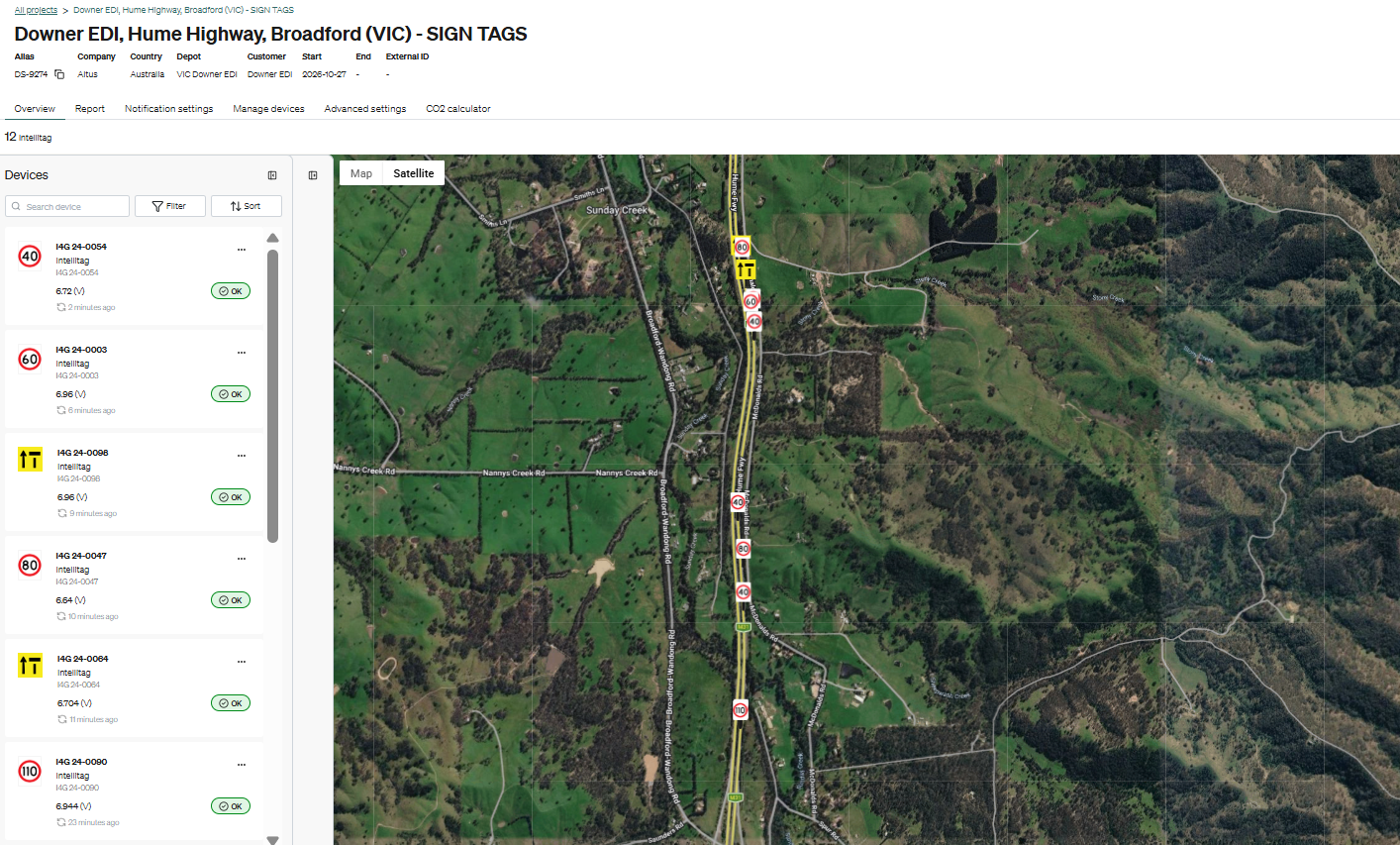
Location: Hume Highway (southbound)
City: Broadford, VIC
Client: Downer EDI
Dates: 27 to 29 October 2026 (speed analysis 20 to 29 October 2026)
On a busy freight corridor north of Melbourne, our worksite became a controlled test of a simple question: once the cones, signs and speed limit are in place, what does Workzone Digitisation change? Forty hours of live operation and 240 hours of independent speed data gave a clear answer.
A worksite that was already doing its job
The Hume Highway at Broadford carries everything from family cars to B-doubles and wide loads. With no worksite in place, traffic moves at highway pace: third party data put the hourly median at 94 km/h, with the 85th percentile at 106 km/h.
When Downer EDI set up its 1.85 km worksite in October 2026, the static controls did what they are designed to do. Speeds fell by roughly 40%, to a median of about 54 km/h. By most measures, that is a well-run site.
But the posted limit was 40 km/h. In the 400m stretch at the southern end of the site, the median ran over that limit in 77 of 80 hours. In nearly three quarters of hours, the fastest 15% of drivers were travelling above 50 km/h. That margin, between a site that slows traffic and a site where traffic actually complies, is where road workers carry the most risk.
Changing one thing, and measuring it
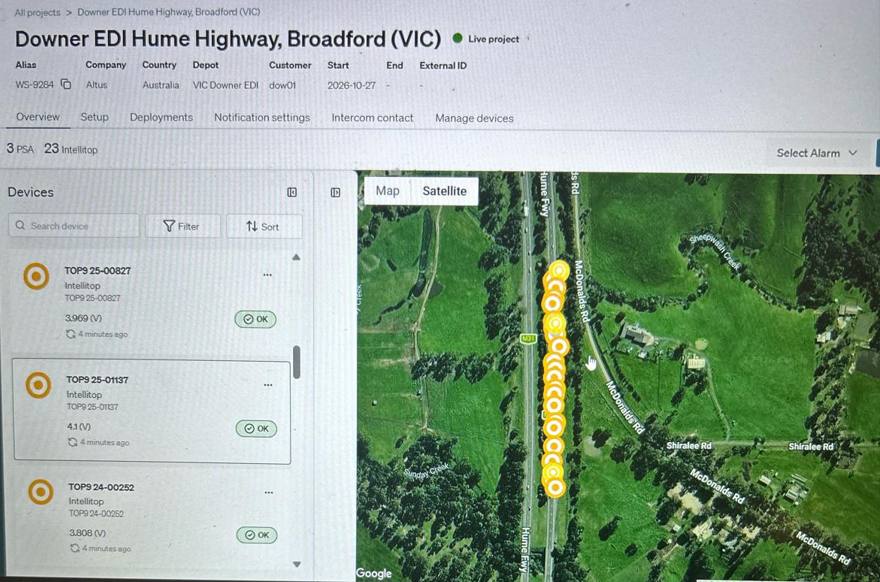
On the evening of Tuesday 27 October, Altus Traffic deployed Workzone Digitisation across that 400m section: 96 smart devices, including Intellitop Cone Sensors, Portable Site Alarms and 12 Intellitag sign tags. Everything else stayed the same. Same site, same limit, same road.
The design of the trial mattered as much as the deployment. Speeds were analysed for every hour from 20 to 29 October, covering the worksite without Workzone Digitisation, a reference period with no worksite at all, and 40 hours with Workzone Digitisation live. Crucially, the 1.85 km approach, which was not digitised, ran alongside the digitised section over the same hours, in the same traffic and the same weather. It became the control.
What the numbers showed
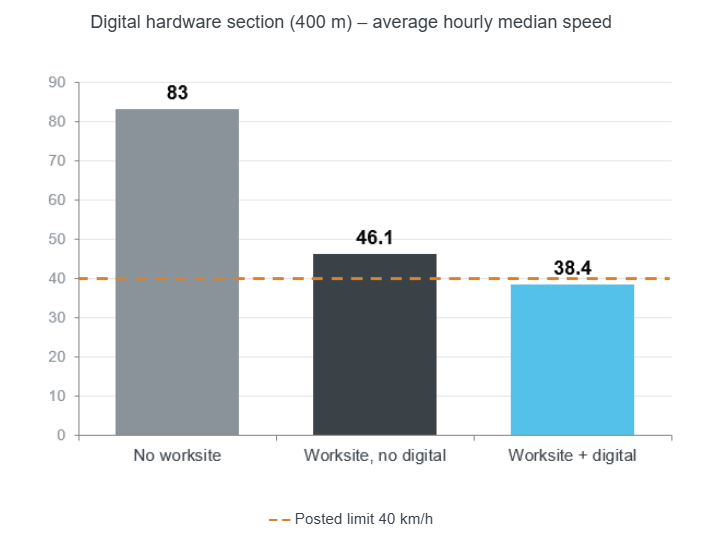
In the digitised section, the average hourly median speed fell from 46.1 km/h to 38.4 km/h. Typical speeds went from about 6 km/h over the limit to just under it. The 85th percentile, the figure that best reflects the drivers most likely to cause harm, fell by 10.7 km/h, from 55.1 to 44.4 km/h.
The share of hours running over the limit dropped from 96% to 40%. Hours where the 85th percentile topped 50 km/h fell from 73% to 25%. During the day, the shift was sharper still: the daytime median fell from 43.8 to 35.9 km/h. The median was lower in 23 of 24 hours of the day.

That comparison is what gives the result its weight. If traffic had simply been lighter, or the week calmer, both sections would have moved together. They did not. The change was concentrated where Workzone Digitisation was deployed, and with afternoon queuing hours removed, the digitised section still settled at a median of 40.3 km/h, right on the limit.
Thirty-eight moments crews didn't have to catch themselves
Lower speeds reduce the chance of an incursion. Real-time alerts reduce what an incursion can cost. Over the 44-hour operational window, the system recorded 56 alarm activations, grouped into 38 separate events.
Most came from public traffic: 23 events, or 61%, involving light vehicles, heavy vehicles and three wide loads. Ten of those vehicles struck cones while travelling at 43 to 58 km/h. Each event notified the onsite crews, was logged, time-stamped and traced to a specific sensor and alarm unit.
The difference between 56 activations and 38 events is a design choice worth noting. When a wide load clipped several cones across different parts of the site, each strike re-triggered the alarms. The crew was warned at every point of contact, not only the first. For reporting, those activations were grouped into a single event.
Overnight, the alarms' lighting told its own story. Cones were struck in parts of the site outside the digitised section, while inside it, heavy vehicles in particular steered clear.
The quieter measures
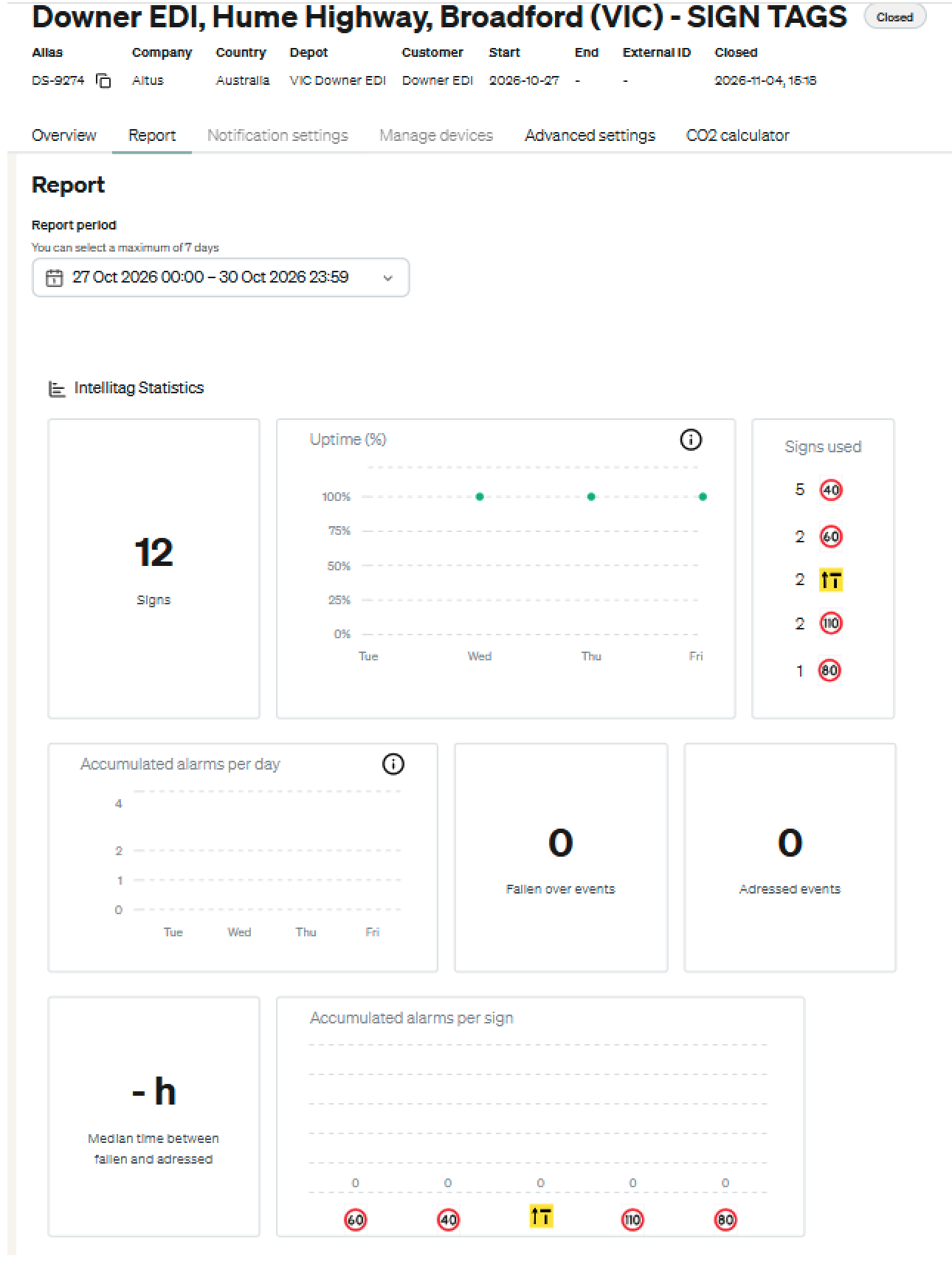
Alongside speed and incursions, the system tracked the conditions drivers were actually experiencing. Average G-force through the site was 0.0639G, with an 85th percentile of 0.0857G, both rated Low / Safe, and there were no hard braking or swerving events. All 12 Intellitag-monitored signs stayed upright for 529 of 529 monitored hours. Weather was clear, dry and rated low risk at 6/100, ruling it out as a factor.
Remote sign monitoring also removed the need for routine signage-check drives. At a 2-hourly check frequency, that avoided 392.9 kg of CO₂e.
Reading the result honestly
Not every number moved in the same direction, and the full picture is part of what makes the result credible. Across all hours, the whole-site 85th percentile rose slightly, by 1.2 km/h, driven by faster overnight traffic on the parts of the site that were not digitised. Speeds in the digitised section were also less uniform, mostly because the slowest vehicles were slower, a sign of stop-start traffic rather than more speeding. What the data does show, consistently, is that where Workzone Digitisation was deployed, drivers slowed to the limit, and crews knew the moment the exclusion zone was breached.
Four hundred metres, measured
Our Broadford worksite joins a growing body of Workzone Digitisation results across projects for clients including Downer, Transurban, Fulton Hogan, Egis, Vida Roads, CPB and work recognised by the NSCA Foundation, the Australian Flexible Pavement Association and Transport for NSW. Click here to find out more.
The value of this trial is not a headline figure. It is the method: one variable changed, a control running alongside, and a result that held. On a road where most drivers were already slowing down, Workzone Digitisation closed the last margin, and gave the people working inside it the warning, and the seconds, they need to get home safely.
Talk to us about the data:
- Find out more about the Workzone Digitisation system here.
- If you would like further information about Workzone Digitisation, please contact our Head of Digital, Beth Lilford at beth.lilford@altusgroup.com.au